A Comparative Analysis of National AI Strategies in UAE, South Korea, France, Singapore, India, and Japan
Abstract
The global race for artificial intelligence supremacy has prompted nations worldwide to pursue sovereign AI capabilities, defined as the ability to develop, deploy, and control AI systems independently of foreign technology providers. This research examines six national AI initiatives, identifying why some countries have produced frontier-class models while others, despite substantial investment, have not. We analyze three success cases (UAE, South Korea, and France) and three underperformance cases (Singapore, India, and Japan), excluding the United States, China, and Canada, which already possess frontier model capabilities through companies like OpenAI, Anthropic, DeepSeek, and Cohere. Our findings reveal that investment scale alone does not predict success. Rather, four interconnected factors determine outcomes: centralized leadership coordination, public-private sector alignment, strategic differentiation from global competitors, and patient capital structures capable of sustaining multi-year development cycles.
1. Introduction
The emergence of large language models and generative AI has fundamentally altered the strategic calculus for national technology policy. Nations that once viewed AI as merely another technology sector now recognize it as foundational infrastructure comparable to electricity grids or telecommunications networks. This recognition has driven unprecedented government investment in what has become known as sovereign AI, the pursuit of domestically controlled AI capabilities that reduce dependence on foreign technology providers.
The stakes extend beyond economic competitiveness. Nations without indigenous AI capabilities face potential vulnerabilities in national security applications, dependency on foreign companies for critical infrastructure, and limited ability to ensure AI systems reflect local values and languages. These concerns have motivated aggressive investment programs across the developed world, yet outcomes have varied dramatically.
This research examines why some national AI strategies have produced competitive results while others have struggled despite significant resource commitment. We focus on six nations representing diverse approaches to sovereign AI development.
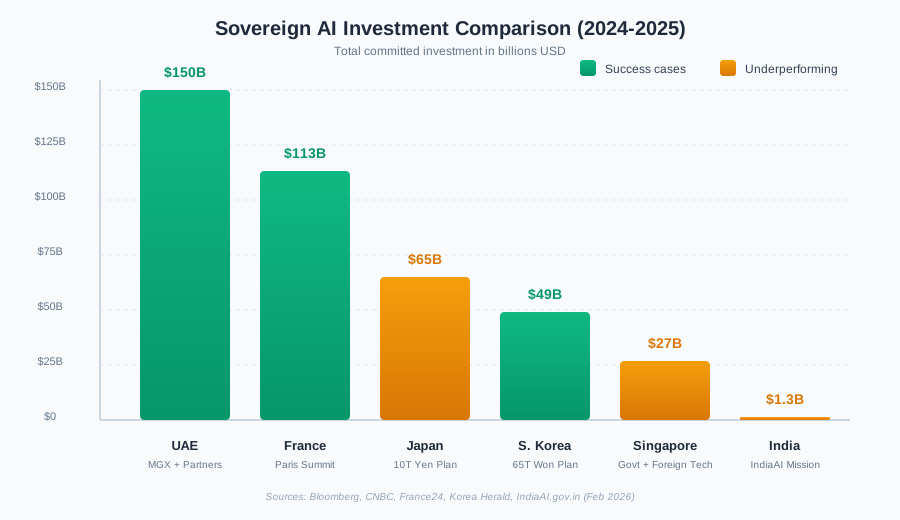
The success group includes the United Arab Emirates, which has committed over $100 billion through vehicles like MGX and developed the Falcon model series [1]; South Korea, which developed HyperCLOVA X and Solar Pro 2 while maintaining leadership in semiconductor manufacturing [2]; and France, home to Mistral AI with its $14 billion valuation as Europe's only frontier AI lab [3].
The underperformance group includes Singapore, which despite $27 billion in ecosystem investment has not produced frontier models even while achieving governance leadership [4]; India, which committed Rs 10,372 crore ($1.3 billion) through the IndiaAI Mission plus substantial private investment but still has models in development [5]; and Japan, which made a ¥10 trillion ($65 billion) commitment yet produces only regional models despite having the world's third-largest R&D spending [6].
2. Methodology
2.1 Case Selection
We selected countries based on three criteria: significant government investment in AI (exceeding $1 billion committed), explicit sovereign AI policy objectives, and sufficient time elapsed to evaluate outcomes (initiatives launched before 2025). We excluded the United States, China, and Canada because these nations already host companies with demonstrated frontier model capabilities, making their situations fundamentally different from countries attempting to establish such capabilities.
2.2 Analysis Framework
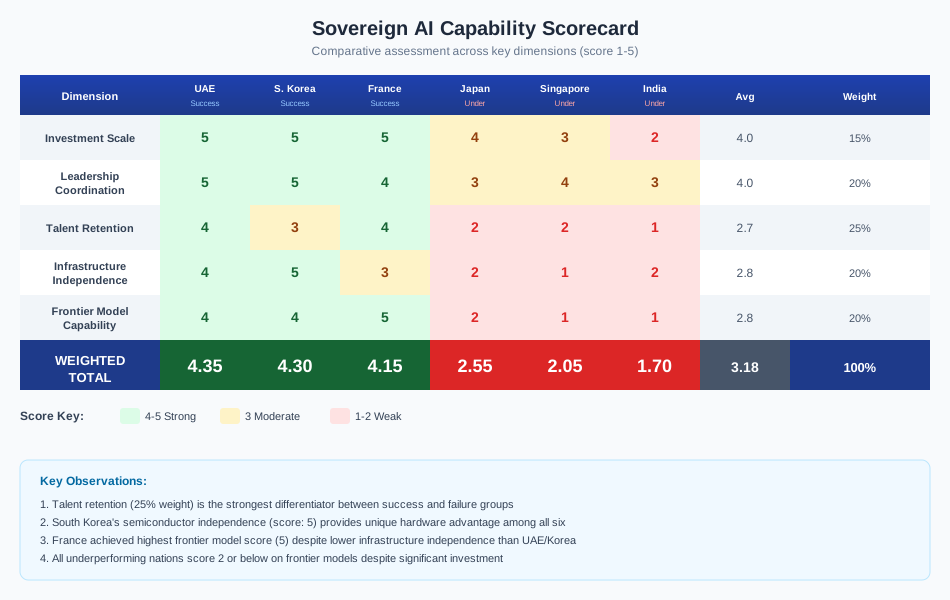
We examined each country across five dimensions: investment scale (total public and private capital committed), leadership coordination (degree of centralized decision-making authority), talent retention (ability to keep elite AI researchers domestically), infrastructure independence (control over compute, semiconductors, and data centers), and frontier model capability (actual competitive AI models produced).
3. The Success Cases
3.1 United Arab Emirates: The Coordinated State Model
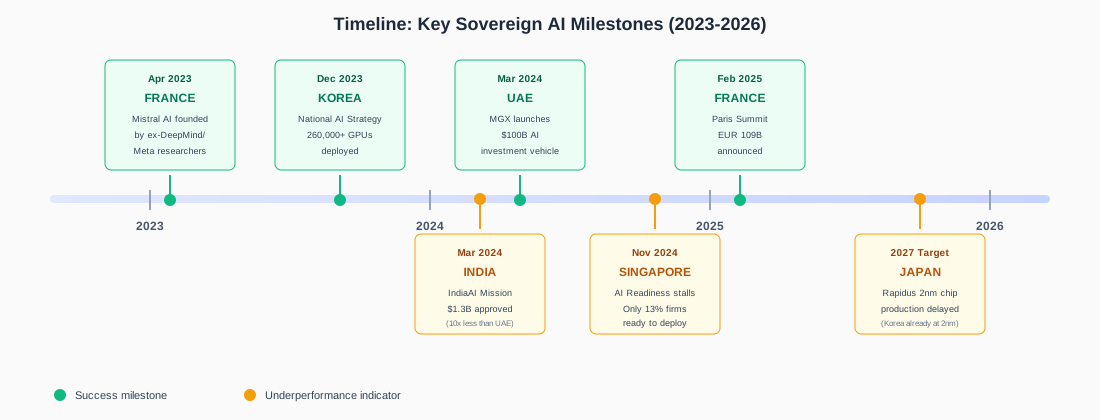
The UAE represents the most aggressive sovereign AI strategy outside major powers, with total commitments exceeding $100 billion [1]. The centerpiece is MGX, a $100 billion AI-focused investment vehicle launched in March 2024 with Sheikh Tahnoon bin Zayed Al Nahyan as chairman [7]. This is complemented by a $1.5 billion Microsoft equity stake in G42, announced in April 2024 as part of a broader $15.2 billion partnership running through 2029 [8]. The Stargate UAE project brings together OpenAI, NVIDIA, Oracle, and SoftBank to build a 1-gigawatt data center in Abu Dhabi, with initial operations launching by end of 2026 [9]. Additionally, the Abu Dhabi government committed AED 13 billion ($3.5 billion) over three years under the UAE National Strategy for Artificial Intelligence 2031 [10].
The UAE's governance represents exceptional coordination. Sheikh Tahnoon bin Zayed Al Nahyan chairs both the AI and Advanced Technology Council and G42, creating unified leadership across strategy and execution [11]. This concentration of authority enables rapid decision-making that would be impossible in more distributed governance structures. When the UAE decided to pivot G42 away from Chinese technology partnerships in response to US concerns, the decision was implemented within months rather than years.
On the capability front, the Technology Innovation Institute released Falcon 2 in May 2024, outperforming Meta's Llama 3 8B on key benchmarks [12]. The Mohamed bin Zayed University of Artificial Intelligence, which has 84 faculty members and over 200 researchers, developed the Jais large language model for Arabic [13]. According to Stanford HAI's Global AI Vibrancy rankings, the UAE now ranks 5th globally and leads the MENA region in AI readiness [14].
The UAE strategy demonstrates that resource abundance, when combined with unified leadership and willingness to import talent, can compress development timelines significantly. However, critics note that much UAE capability depends on foreign partnerships and imported expertise rather than indigenous development.
3.2 South Korea: The Semiconductor Advantage
South Korea's AI strategy leverages its existing dominance in semiconductor manufacturing to pursue AI leadership. The government has committed approximately ¥10.1 trillion won ($7 billion) for 2026, triple the 2025 allocation of 3.3 trillion won [15]. This public investment catalyzes vastly larger private commitments, with SK Group aiming to secure $56 billion by 2026 for AI and chip investments [16], and Samsung announcing a 450 trillion won expansion plan [17].
Infrastructure deployment has been aggressive. NVIDIA announced supply of 260,000+ AI chips to South Korea, distributed across Samsung (50,000), SK Group (50,000), Hyundai (50,000), Naver Cloud (60,000), and the National AI Computing Center [18]. This scale of deployment enables domestic model training that would otherwise require foreign cloud providers.
Most significantly, South Korea has produced genuine frontier capabilities. Upstage's Solar Pro 2, launched in July 2025 with 31 billion parameters, achieved recognition as Korea's first frontier-scale LLM outperforming GPT-4.1 in global rankings [19]. Naver's HyperCLOVA X, trained on 6,500 times more Korean data than GPT-4, dominates domestic language understanding [20]. Samsung's Gauss 2 supports 9-14 languages and offers three model variants for enterprise deployment [21].
The semiconductor dimension provides unique advantage. Samsung began mass production of 2nm Gate-All-Around (GAA) chips with the Exynos 2600, achieving 113% AI performance improvement over the previous generation [22]. This positions Korea to potentially reduce dependence on TSMC and build a vertically integrated AI ecosystem from chips to models.
Regulatory frameworks have evolved to support innovation. The Framework Act on the Development of Artificial Intelligence, promulgated in January 2025, represents the second comprehensive AI law globally after the EU, balancing innovation promotion with safety requirements [23]. Presidential commitment manifested in the AI Seoul Summit, where President Yoon Suk Yeol established Korea's role in international AI governance [24].
3.3 France: The Open-Source Champion
France has positioned itself as the European leader in AI through a combination of strategic investment and cultivation of a single dominant player. At the February 2025 AI Action Summit in Paris, President Macron announced €109 billion in private-sector AI commitments, described as France's equivalent of the US Stargate project [25]. Bpifrance, the national investment bank, is deploying €10 billion to develop the AI ecosystem and facilitate AI adoption by French companies [26].
The Mistral AI story exemplifies France's strategy. Founded in April 2023 by former DeepMind and Meta researchers, Mistral has become Europe's only frontier AI laboratory [27]. By September 2025, Mistral achieved a $14 billion valuation with ASML taking a major stake [3]. The company's Mistral 3 model family, launched December 2025, includes open-weight models designed for laptops, drones, and edge devices, differentiating from competitors focused solely on cloud deployment [28].
Infrastructure investments support this ecosystem. MGX, Bpifrance, NVIDIA, and Mistral announced plans for a 1.4-gigawatt Paris data center campus, which would be Europe's largest AI computing facility [29]. France also established INESIA (Institut National pour l'Évaluation et la Sécurité de l'Intelligence Artificielle) in February 2025 to assess AI security with participation from Inria and LNE [30].
President Macron has personally championed AI development, declaring France's intention to become an AI powerhouse [31]. This high-level political support provides policy continuity that enables long-term planning by companies like Mistral.
France's strategy demonstrates that smaller nations can achieve frontier capabilities by concentrating resources on a single national champion while creating supportive infrastructure and regulatory environments. The open-source focus also creates differentiation from US competitors dominated by proprietary models.
4. The Underperformance Cases
4.1 Singapore: Governance Without Models
Singapore presents a paradox: global leadership in AI governance combined with absence of frontier model capability. The nation has channeled approximately $27 billion in combined public and private funding into AI, including S$1.6 billion in government funding complemented by major tech investments from AWS ($9 billion), Google ($5 billion), and Microsoft [4]. Singapore launched its National AI Strategy 2.0 in December 2023 [32] and Smart Nation 2.0 in October 2024 [33], demonstrating sustained policy attention.
Singapore's AI Verify framework, launched by IMDA in 2022, became the world's first AI governance testing framework with 11 principles aligned with international standards [34]. The Model AI Governance Framework for Generative AI followed in 2024 [35]. These governance innovations have earned Singapore recognition: Oxford Insights ranks Singapore 2nd globally in government AI readiness [36].
Yet Singapore has not produced competitive AI models. SEA-LION, developed by AI Singapore, serves Southeast Asian languages but does not compete at the frontier level [37]. According to Cisco's 2024 AI Readiness Index, only 13% of Singapore organizations are fully prepared to deploy AI, unchanged from the previous year [38]. A Georgetown CSET report identified a fundamental constraint: Singapore produced only 2,800 ICT graduates in 2020 against demand of 60,000 through 2024 [39].
The core problem is market scale. Singapore's 5.9 million population cannot generate sufficient training data for large language models or provide the domestic market to justify frontier model development costs. US technology companies use Singapore primarily as an Asia-Pacific headquarters and talent hub rather than as a site for core AI development. This creates a structural dependency where Singapore excels at AI deployment and governance but cannot achieve production independence.
4.2 India: Scale Without Coordination
India possesses advantages that should enable AI success: 1.4 billion people generating vast training data, a large English-speaking technical workforce, and established IT services industry. The IndiaAI Mission, approved in March 2024 with Rs 10,372 crore ($1.3 billion) funding, aims to build computing infrastructure and indigenous AI capabilities [5]. The BHASHINI mission addresses India's 22 scheduled languages with translation capabilities [40].
Private investment has been substantial. Krutrim, founded by Ola's Bhavish Aggarwal, became India's first AI unicorn in January 2024 [41] and announced a $1.2 billion investment commitment through 2026 for a frontier research lab [42]. Sarvam AI was selected to build India's first indigenous AI model under the IndiaAI Mission [43]. Reliance partnered with Brookfield to invest $11 billion in AI data center infrastructure in Andhra Pradesh [44].
Despite this activity, India has not produced frontier models. The Tortoise Global AI Index shows India advancing to the top 10, and Stanford HAI ranks India 4th in AI vibrancy [45], but these rankings measure ecosystem activity rather than model capability. Actual frontier models remain in development.
Several factors explain the gap. India suffers severe brain drain, with 3.12 million highly educated migrants and approximately one-third of IIT graduates emigrating [46]. US export controls classify India as Tier 2, limiting GPU imports to roughly 50,000 H100-equivalent chips through 2027 [47]. Infrastructure gaps persist: India generates 20% of global data but has only 3% of global data center capacity [48]. The IndiaAI Mission budget of $1.3 billion represents less than 2% of UAE's commitment, constraining compute scale.
4.3 Japan: Investment Without Risk-Taking
Japan represents perhaps the most puzzling case. The nation committed ¥10 trillion ($65 billion) in public support through 2030 as part of the AI and Semiconductor Industry Strengthening Framework [6]. SoftBank has made massive AI investments globally, including full funding of a $40 billion investment in OpenAI through the Stargate Project [49]. Microsoft committed $2.9 billion to Japan AI infrastructure [50], and AWS announced $15.2 billion in Japan infrastructure investment [51].
Japan hosts world-class AI infrastructure. The country deployed what NVIDIA claims is the world's largest DGX SuperPOD [52]. Rapidus, Japan's semiconductor revival project, demonstrated working 2nm chip prototypes and targets mass production in H2 2027 [53]. The AI Promotion Act, passed May 2025 and effective June 2025, created an innovation-first regulatory framework [54].
Yet Japan has not produced frontier models despite these advantages. SoftBank's Sarashina LLM, launched as a 460-billion-parameter model with API services in November 2025, serves enterprise users but does not compete globally [55]. Sakana AI, founded by former Google researchers and valued at $2.65 billion after November 2025 fundraising, represents Japan's most prominent AI startup but focuses on efficiency rather than frontier scale [56].
Cultural factors appear determinative. The Global Entrepreneurship Monitor ranks Japan 47th globally in entrepreneurial intentions, with only 3.2% expressing interest in starting businesses [57]. Only 23.5% of Japanese SMEs use generative AI, the lowest rate among surveyed countries [58]. This risk aversion extends to corporate strategy: Japanese companies prefer cautious iteration over the aggressive scaling that characterizes frontier AI development.
Japan also faces demographic headwinds. The IT personnel shortage is projected to reach 360,000-790,000 by 2030 [59]. Unlike Singapore, Japan cannot easily import talent due to language barriers and immigration restrictions.
5. Comparative Analysis
5.1 Success Factors
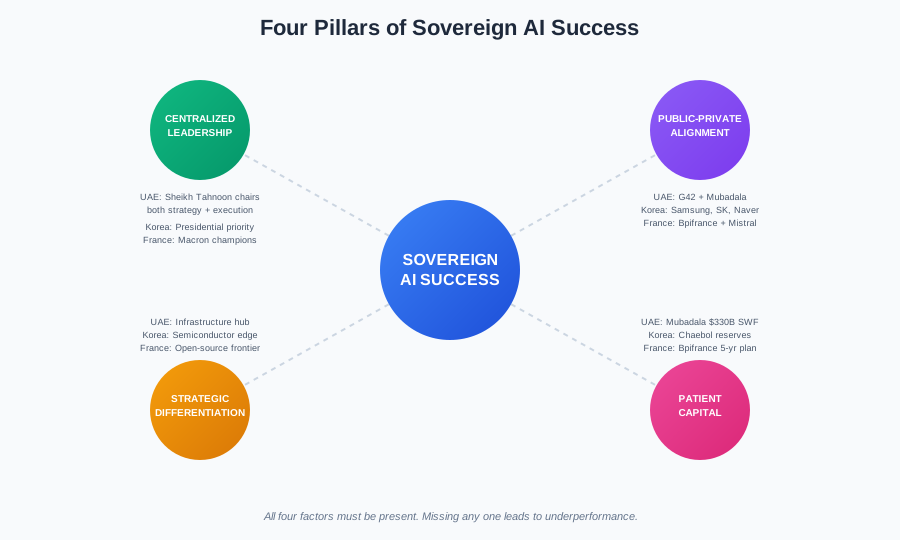
Analysis across all six cases reveals four factors that distinguish success from underperformance.
Centralized leadership coordination appears necessary for rapid execution. The UAE concentrates authority in Sheikh Tahnoon across investment and technology councils. Korea operates through presidential priority with chaebol alignment. France has President Macron personally championing Mistral. By contrast, Singapore distributes authority across multiple agencies, India fragments across states and ministries, and Japan diffuses responsibility across keiretsu without clear coordination.
Public-private sector alignment enables resource mobilization at scale. UAE's sovereign wealth funds invest alongside G42 and international partners. Korea's chaebols (Samsung, SK, Naver) commit private capital alongside government programs. France's Bpifrance co-invests with Mistral. Underperforming nations show weaker alignment: Singapore relies heavily on foreign tech companies, India's private sector operates independently of government strategy, and Japan's corporations pursue cautious strategies despite available government support.
Strategic differentiation from global competitors provides viable paths to success. The UAE positions as a neutral infrastructure hub bridging East and West. Korea leverages semiconductor dominance to build vertically integrated AI. France champions open-source models as alternatives to US proprietary offerings. Singapore, India, and Japan have not articulated clear differentiation strategies, instead pursuing generic AI development that competes directly with better-resourced US and Chinese efforts.
Patient capital structures enable sustained investment through development cycles measured in years. UAE's sovereign wealth funds operate on multi-generational timelines. Korea's chaebols maintain long-term investment horizons. France's Bpifrance provides 5-year funding commitments. Underperforming nations face shorter time horizons: Singapore depends on foreign venture capital with standard exit timelines, India's startup ecosystem prioritizes rapid returns, and Japan's corporate capital deployment requires near-term justification.
5.2 Failure Patterns
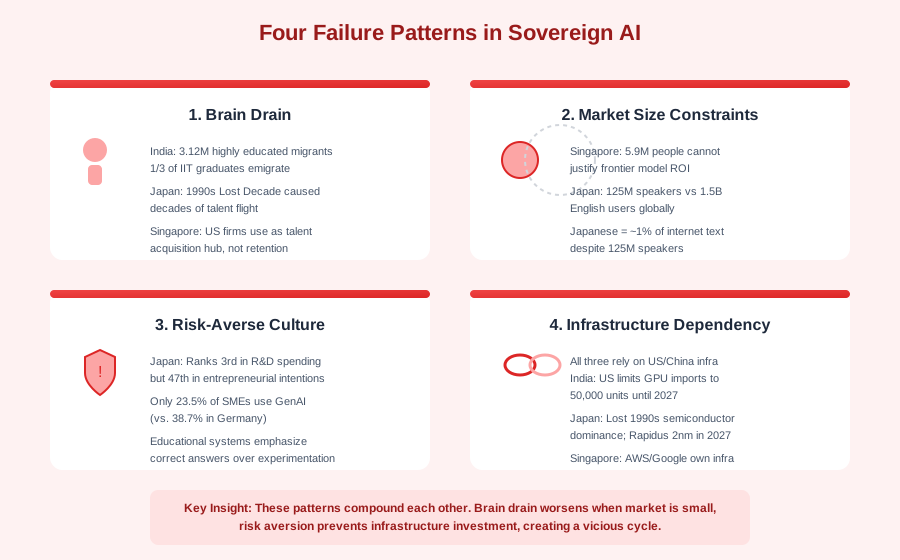
Four patterns characterize underperformance.
Brain drain afflicts all three underperforming nations but manifests differently. Singapore loses talent to higher-paying US tech company offices elsewhere in Asia. India exports its best technical graduates to Silicon Valley. Japan loses entrepreneurial talent to more dynamic ecosystems while struggling to attract foreign researchers due to language barriers.
Market size constraints prevent economic justification for frontier investment. Singapore's 5.9 million people cannot generate training data or domestic demand sufficient for frontier models. Japan's 125 million speakers represent less than 1% of global internet text despite population scale. India's linguistic diversity fragments potential markets across 22 major languages.
Risk-averse institutional culture inhibits the aggressive investment required for frontier development. Japan exemplifies this pattern with minimal entrepreneurial intention and low SME AI adoption. Singapore's government-linked corporations prioritize stability over breakthrough innovation. India's IT services industry optimizes for predictable margin rather than speculative AI development.
Infrastructure dependency on foreign providers creates strategic vulnerability. All three underperforming nations depend on US cloud providers (AWS, Google Cloud, Microsoft Azure) for AI computing. India faces explicit US export controls on advanced chips. Singapore hosts major data centers owned by foreign companies. Japan's semiconductor industry lost global position in the 1990s and is only now attempting recovery through Rapidus.
6. Discussion
6.1 Investment Scale is Necessary But Not Sufficient
Japan's experience demonstrates that investment scale alone does not produce frontier capability. Despite $65 billion in commitments matching Korea's investment, Japan has not produced competitive models. The UAE's success with relatively less total investment (when measured against GDP) suggests that resource allocation efficiency and execution capability matter more than absolute scale.
6.2 Governance Leadership Does Not Guarantee Production Capability
Singapore's global leadership in AI governance frameworks has not translated to model development capability. This suggests governance and production require different institutional capabilities. Nations may need to choose strategic priorities rather than attempting excellence across all dimensions.
6.3 Talent is the Binding Constraint
Across all cases, talent availability correlates more strongly with success than any other factor. France attracted former DeepMind and Meta researchers to found Mistral. Korea retained technical talent through competitive compensation and national pride. The UAE imported talent through attractive lifestyle and compensation packages. Underperforming nations either export talent (India), cannot attract it (Japan), or host it temporarily for foreign employers (Singapore).
6.4 Semiconductor Capability Provides Structural Advantage
Korea's semiconductor leadership creates options unavailable to other nations. Indigenous chip production reduces dependency on foreign suppliers, enables hardware-software co-optimization, and provides negotiating leverage in international technology relationships. Japan's Rapidus project represents recognition of this dynamic, though results remain uncertain.
7. Conclusions
Sovereign AI capability requires more than financial resources. Our analysis identifies four necessary conditions: centralized leadership enabling rapid decisions, public-private alignment mobilizing combined resources, strategic differentiation avoiding direct competition with US and Chinese leaders, and patient capital sustaining multi-year development.
Success cases demonstrate viable paths. The UAE shows that smaller nations can achieve capability through unified leadership and willingness to import talent. Korea demonstrates that semiconductor advantages can be leveraged into AI leadership. France proves that open-source differentiation enables competition against larger players.
Underperformance cases reveal structural barriers that investment cannot easily overcome. Market size constraints fundamentally limit Singapore's options. Brain drain undermines India's talent advantage. Cultural risk aversion prevents Japan from translating resources into frontier development.
For policymakers, implications are clear. Investment programs should be evaluated not by scale but by presence of the four success factors. Nations lacking these conditions should consider whether sovereign AI capability is achievable or whether alternative strategies (governance leadership, application deployment, regional specialization) might prove more realistic.
The sovereign AI race will produce few winners. Resources are concentrating among nations that demonstrate ability to translate investment into capability. Those that cannot may find themselves dependent on foreign AI providers for critical infrastructure, regardless of their investment intentions.
References
[1] CSIS. "The United Arab Emirates' AI Ambitions." Center for Strategic and International Studies, 2024. https://www.csis.org/analysis/united-arab-emirates-ai-ambitions
[2] NVIDIA. "NVIDIA, South Korea Government and Industrial Giants Build AI Infrastructure." NVIDIA Newsroom, November 2024. https://nvidianews.nvidia.com/news/south-korea-ai-infrastructure
[3] CNBC. "AI firm Mistral valued at $14 billion as chip giant ASML takes major stake." CNBC, September 9, 2025. https://www.cnbc.com/2025/09/09/ai-firm-mistral-valued-at-14-billion-as-asml-takes-major-stake.html
[4] Introl. "Singapore's $27B AI Revolution Powers Southeast Asia 2025." Introl Blog, 2025. https://introl.com/blog/singapore-ai-revolution-27-billion-investment-2025
[5] IndiaAI. "Cabinet approves India AI mission at an outlay of Rs 10,372 crore." IndiaAI, March 7, 2024. https://indiaai.gov.in/news/cabinet-approves-india-ai-mission-at-an-outlay-of-rs-10-372-crore
[6] Science Japan. "Japan aims to raise usage of AI to 80% to catch up with global peers." Japan Science and Technology Agency, November 2024. https://sj.jst.go.jp/news/202512/n1210-01n.html
[7] Bloomberg. "Abu Dhabi Targets $100 Billion AUM for AI Investment Firm MGX." Bloomberg, March 11, 2024. https://www.bloomberg.com/news/articles/2024-03-11/abu-dhabi-said-to-target-100-billion-aum-for-ai-investment-firm
[8] Microsoft. "Microsoft invests $1.5 billion in Abu Dhabi's G42." Microsoft News, April 16, 2024. https://news.microsoft.com/source/2024/04/16/microsoft-invests-1-5-billion-in-abu-dhabis-g42-to-accelerate-ai-development-and-global-expansion/
[9] OpenAI. "Introducing Stargate UAE." OpenAI, May 22, 2025. https://openai.com/index/introducing-stargate-uae/
[10] UAE Government. "UAE Strategy for Artificial Intelligence." Official UAE Government Platform, 2024. https://u.ae/en/about-the-uae/strategies-initiatives-and-awards/strategies-plans-and-visions/government-services-and-digital-transformation/uae-strategy-for-artificial-intelligence
[11] Gulf Business. "HH Sheikh Tahnoon Bin Zayed Al Nahyan - 100 Most Powerful Arabs 2025." Gulf Business, 2025. https://gulfbusiness.com/lists/100-most-powerful-arabs-2025/hh-sheikh-tahnoon-bin-zayed-al-nahyan/
[12] Technology Innovation Institute. "Falcon 2: UAE's Technology Innovation Institute Releases New AI Model Series." TII, May 2024. https://www.tii.ae/news/falcon-2-uaes-technology-innovation-institute-releases-new-ai-model-series-outperforming-metas-new-llama-3
[13] MBZUAI. "Mohamed bin Zayed University of Artificial Intelligence." MBZUAI Official, 2025. https://mbzuai.ac.ae/
[14] Stanford HAI. "Global AI Power Rankings: Stanford HAI Tool Ranks 36 Countries in AI." Stanford HAI, 2025. https://hai.stanford.edu/news/global-ai-power-rankings-stanford-hai-tool-ranks-36-countries-in-ai
[15] Korea Herald. "How 260000 Nvidia chips could redefine Korea's AI Ambitions." Korea Herald, 2024. https://www.koreaherald.com/article/10606845
[16] Nikkei Asia. "SK Group aims to secure $56bn by 2026 to invest in AI and chips." Nikkei Asia, 2024. https://asia.nikkei.com/business/technology/artificial-intelligence/sk-group-aims-to-secure-56bn-by-2026-to-invest-in-ai-and-chips
[17] Samsung Newsroom. "Samsung Developer Conference Korea 2024." Samsung Global Newsroom, November 2024. https://news.samsung.com/global/samsung-electronics-hosts-samsung-developer-conference-korea-2024-unveils-its-improved-gen-ai-model
[18] NVIDIA. "NVIDIA, South Korea Government and Industrial Giants Build AI Infrastructure." NVIDIA Newsroom, November 2024. https://nvidianews.nvidia.com/news/south-korea-ai-infrastructure
[19] Upstage. "Solar Pro 2: Fluent. Reasoning. Frontier." Upstage Blog, July 21, 2025. https://www.upstage.ai/blog/en/solar-pro-2-launch
[20] Naver. "HyperCLOVA X." CLOVA AI, 2024. https://clova.ai/en/hyperclova
[21] Samsung Research. "Artificial Intelligence." Samsung Research, 2025. https://research.samsung.com/artificial-intelligence
[22] Samsung Semiconductor. "Exynos 2600." Samsung Semiconductor, December 2025. https://semiconductor.samsung.com/processor/mobile-processor/exynos-2600/
[23] CSET Georgetown. "Framework Act on the Development of Artificial Intelligence - South Korea." CSET, January 2025. https://cset.georgetown.edu/publication/south-korea-ai-law-2025/
[24] Ministry of Foreign Affairs Korea. "Opening Remarks by President Yoon Suk Yeol at the AI Seoul Summit." MOFA, May 2024. https://lby.mofa.go.kr/eng/brd/m_25772/view.do?seq=37
[25] France 24. "Tech titans and government leaders gather in Paris for landmark AI summit." France 24, February 10, 2025. https://www.france24.com/en/europe/20250210-government-tech-leaders-paris-ai
[26] Bpifrance. "Bpifrance deploys €10 billion to develop the AI ecosystem." Bpifrance, March 27, 2025. https://www.bpifrance.com/2025/03/27/bpifrance-deploys-e10-billion-to-develop-the-ai-ecosystem-and-facilitate-the-adoption-of-artificial-intelligence-by-french-companies/
[27] Wikipedia. "Mistral AI." Wikipedia, 2025. https://en.wikipedia.org/wiki/Mistral_AI
[28] Mistral AI. "Introducing Mistral 3." Mistral AI, December 2, 2025. https://mistral.ai/news/mistral-3
[29] DataCenter Dynamics. "MGX, Bpifrance, Nvidia, and Mistral AI plan 1.4GW Paris data center campus." DataCenter Dynamics, 2025. https://www.datacenterdynamics.com/en/news/mgx-bpifrance-nvidia-and-mistral-ai-plan-14gw-paris-data-center-campus/
[30] Campus France. "The French government creates a national institute to assess and secure AIs (INESIA)." Campus France, 2025. https://www.campusfrance.org/en/actu/creation-d-un-institut-national-pour-l-evaluation-et-la-securite-de-l-ia
[31] Élysée. "Make France an AI powerhouse." Office of the President of France, February 11, 2025. https://www.elysee.fr/en/emmanuel-macron/2025/02/11/make-france-an-ai-powerhouse
[32] Smart Nation Singapore. "National AI Strategy." Smart Nation Singapore, December 2023. https://www.smartnation.gov.sg/initiatives/national-ai-strategy/
[33] Smart Nation Singapore. "Smart Nation 2.0." Smart Nation Singapore, October 2024. https://www.smartnation.gov.sg/about/our-vision/sn2/
[34] IMDA. "Singapore launches world's first AI testing framework (AI Verify)." IMDA, 2022. https://www.imda.gov.sg/resources/press-releases-factsheets-and-speeches/press-releases/2022/sg-launches-worlds-first-ai-testing-framework-and-toolkit-to-promote-transparency
[35] IMDA. "Public Consultation on Model AI Governance Framework for GenAI." IMDA, 2024. https://www.imda.gov.sg/resources/press-releases-factsheets-and-speeches/press-releases/2024/public-consult-model-ai-governance-framework-genai
[36] Oxford Insights. "Government AI Readiness Index 2025." Oxford Insights, 2025. https://oxfordinsights.com/ai-readiness/government-ai-readiness-index-2025/
[37] AI Singapore. "SEA-LION: Empowering Open Multilingual AI for Southeast Asia." AI Singapore, 2024. https://sea-lion.ai/
[38] Cisco. "AI Readiness Index - Singapore." Cisco, 2024. https://www.cisco.com/c/dam/m/en_us/solutions/ai/readiness-index/2024-m11/documents/cisco-ai-readiness-index-sg.pdf
[39] CSET Georgetown. "Examining Singapore's AI Progress." CSET, March 2023. https://cset.georgetown.edu/publication/examining-singapores-ai-progress/
[40] BHASHINI. "National Language Translation Mission." Ministry of Electronics and IT, Government of India, 2024. https://bhashini.gov.in/
[41] TechCrunch. "Ola founder's Krutrim becomes India's first AI unicorn." TechCrunch, January 26, 2024. https://techcrunch.com/2024/01/26/ola-founder-ai-startup-krutrim-unicorn-in-50m-funding/
[42] Business Wire. "Krutrim Launches India's First Frontier Research AI Lab." Business Wire, February 4, 2025. https://www.businesswire.com/news/home/20250204723028/en/Krutrim-Launches-Indias-First-Frontier-Research-AI-Lab-to-Democratise-AI-Innovation-Commits-Investment-of-$1.2-Billion-by-Next-Year
[43] Sarvam AI. "Sarvam AI - Sovereign Indian AI Ecosystem." Sarvam AI, 2025. https://www.sarvam.ai/
[44] Bloomberg. "Reliance Joint Venture to Build $11 Billion Data Center in India." Bloomberg, November 27, 2025. https://www.bloomberg.com/news/articles/2025-11-27/reliance-venture-to-build-11-billion-ai-data-center-in-india
[45] IndiaAI. "India ranked fourth in global AI vibrancy ranking." IndiaAI, 2025. https://indiaai.gov.in/article/india-ranked-fourth-in-global-ai-vibrancy-ranking-insights-from-stanford-hai-s-global-ai-vibrancy-tool
[46] IIMAD. "Tackling India's Brain Drain: Evaluating the PMRF Scheme." International Institute for Migration & Development, 2024. https://iimad.org/publications/tackling-indias-brain-drain-evaluating-the-pmrf-scheme/
[47] IAS Gyan. "India Faces GPU Export Limits: UPSC Current Affairs." IAS Gyan, 2025. https://www.iasgyan.in/daily-current-affairs/new-us-ai-export-rule
[48] Introl. "India AI Infrastructure: $10B Investment Guide 2025." Introl Blog, 2025. https://introl.com/blog/indias-ai-infrastructure-revolution-10b-investment-opportunities-in-2025
[49] CNBC. "SoftBank has fully funded $40 billion investment in OpenAI." CNBC, December 30, 2025. https://www.cnbc.com/2025/12/30/softbank-openai-investment.html
[50] Microsoft Japan. "Microsoft Japan AI Investment." Microsoft, April 2024. https://news.microsoft.com/ja-jp/2024/04/japan-ai-investment/
[51] AWS. "AWS Japan Infrastructure Investment." Amazon, 2024. https://aws.amazon.com/blogs/aws/aws-japan-infrastructure-investment/
[52] NVIDIA. "Japan Hosts World's Largest DGX SuperPOD." NVIDIA, 2025. https://nvidianews.nvidia.com/news/japan-dgx-superpod
[53] DigiTimes. "Rapidus showcases 2nm chip prototypes, eying 2027 mass production." DigiTimes, July 2025. https://www.digitimes.com/news/a20250718PD228/rapidus-production-2nm-2027-chips.html
[54] Future of Privacy Forum. "Understanding Japan's AI Promotion Act." FPF, May 2025. https://fpf.org/blog/understanding-japans-ai-promotion-act-an-innovation-first-blueprint-for-ai-regulation/
[55] SoftBank. "SoftBank Corp. and SB Intuitions Launch Sarashina mini API." SoftBank Corp., November 5, 2025. https://www.softbank.jp/en/corp/news/press/sbkk/2025/20251105_01/
[56] TechCrunch. "Sakana AI raises $135M Series B at a $2.65B valuation." TechCrunch, November 17, 2025. https://techcrunch.com/2025/11/17/sakana-ai-raises-135m-series-b-at-a-2-65b-valuation-to-continue-building-ai-models-for-japan/
[57] GEM Consortium. "Entrepreneurship in Japan." Global Entrepreneurship Monitor, 2025. https://www.gemconsortium.org/country-profile/76
[58] Cognizant. "Japanese businesses can unleash gen AI by addressing top inhibitors." Cognizant, 2025. https://www.cognizant.com/us/en/insights/insights-blog/japan-generative-ai-adoption
[59] Linux Foundation. "2025 Japan Tech Talent Report." Linux Foundation, 2025. https://www.linuxfoundation.org/press/2025-japan-tech-talent-report-now-live
Research compiled February 2026. All URLs verified at time of publication.